🔬 Biology · Class 12 · NEET
Reproduction in Organisms - Practice Questions with Answers
75 free MCQs on Reproduction in Organisms with worked answers and explanations. Asexual and sexual reproduction, flower anatomy, pollination, fertilization, and seed development.
Take the timed Reproduction in Organisms chapterwise test →Below are 75 practice questions on Reproduction in Organisms, sorted Easy → Hard. Tap “Show answer & explanation” under any question to check yourself. Want the full theory first? Read the Reproduction in Organisms notes.
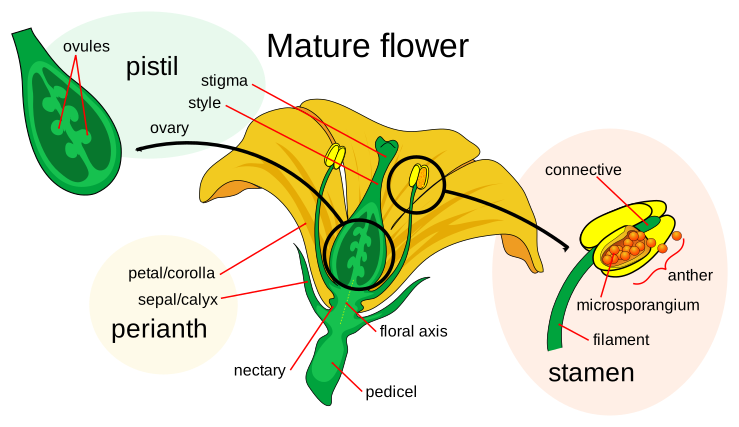
Structure of a mature flower. Image: LadyofHats (Mariana Ruiz), Public Domain, via Wikimedia Commons.
Easy - 25 questions
Q1.
The special mass of cells that helps sponges reproduce asexually is called the:
- A Gemmule
- B Conidium
- C Zoospore
- D Bulbil
Show answer & explanation
Answer: A. Gemmule
Why: Sponges reproduce asexually by producing internal buds called gemmules, which are resistant masses of cells.
Q2.
In filamentous algae and some fungi, the motile asexual spores produced are called:
- A Gemmules
- B Zoospores
- C Conidia
- D Basidiospores
Show answer & explanation
Answer: B. Zoospores
Why: Many algae and aquatic fungi reproduce asexually through motile, flagellated spores called zoospores.
Q3.
Reproduction in which offspring are formed from a single parent without gamete fusion is:
- A Syngamy
- B Sexual reproduction
- C Asexual reproduction
- D Amphimixis
Show answer & explanation
Answer: C. Asexual reproduction
Why: Asexual reproduction involves a single parent and does not involve the fusion of gametes, producing genetically identical offspring.
Q4.
The fusion of the haploid male and female gametes to form a diploid zygote is called:
- A Fragmentation
- B Meiosis
- C Budding
- D Syngamy
Show answer & explanation
Answer: D. Syngamy
Why: Syngamy (fertilisation) is the fusion of two haploid gametes to form the diploid zygote.
Q5.
In organisms like Hydra and yeast, a new individual develops as an outgrowth from the parent body. This is:
- A Budding
- B Binary fission
- C Fragmentation
- D Sporulation
Show answer & explanation
Answer: A. Budding
Why: In budding, a bud arises as an outgrowth on the parent body and detaches to become a new individual, as in Hydra and yeast.
Q6.
Grafting in plants is done to:
- A Boost the number of seeds a plant yields
- B Combine desirable traits of two varieties onto one plant
- C Increase the rate of chlorophyll synthesis in leaves
- D Generate an entirely new species through hybridization
Show answer & explanation
Answer: B. Combine desirable traits of two varieties onto one plant
Why: Grafting: shoot (scion) of one plant joined to root (rootstock) of another. Combines disease-resistant roots with high-quality fruit varieties.
Q7.
Spores in ferns are produced by:
- A Seeds formed after fertilization of the ovule
- B Pollen grains released from the anther
- C Meiosis in sporangia (on undersides of fronds)
- D Rhizome fragmentation alone, without spore formation
Show answer & explanation
Answer: C. Meiosis in sporangia (on undersides of fronds)
Why: Fern spores are produced by meiosis in sporangia (groups called sori) on the underside of fronds. Spores germinate into small gametophyte plants.
Q8.
In bryophytes (mosses), the dominant generation is the:
- A Sporophyte, which bears the capsule on a stalk
- B Gametophyte (the green plant you see)
- C Sporophyte and gametophyte in exactly equal proportion
- D The protonema stage, which dominates over both generations
Show answer & explanation
Answer: B. Gametophyte (the green plant you see)
Why: In mosses (bryophytes), the gametophyte is the dominant, independent generation. The sporophyte (spore-producing) grows on and depends on the gametophyte.
Q9.
Reproduction that involves a single parent and produces genetically identical offspring is:
- A sexual reproduction
- B cross-pollination
- C asexual reproduction
- D syngamy
Show answer & explanation
Answer: C. asexual reproduction
Why: Asexual reproduction needs only one parent and yields offspring genetically identical to it (clones).
Q10.
The fusion of a male and a female gamete is called:
- A pollination
- B germination
- C gametogenesis
- D fertilisation
Show answer & explanation
Answer: D. fertilisation
Why: Fertilisation (syngamy) is the fusion of two gametes to form a diploid zygote.
Q11.
Genetically identical offspring produced from a single parent are known as:
- A mutants
- B hybrids
- C clones
- D zygotes
Show answer & explanation
Answer: C. clones
Why: Because asexual reproduction involves no gamete fusion, the offspring are exact copies called clones.
Q12.
Binary fission is a common mode of asexual reproduction in:
- A Amoeba
- B a mango tree
- C a frog
- D a human
Show answer & explanation
Answer: A. Amoeba
Why: Amoeba divides into two daughter cells by binary fission, an asexual process.
Q13.
Reproduction involving a single parent is called what?
- A Asexual
- B the plain sexual type
- C a two-parent method
- D only external fusion
Show answer & explanation
Answer: A. Asexual
Why: Asexual reproduction needs only one parent and no gamete fusion.
Q14.
Offspring produced by asexual reproduction are called what?
- A Clones
- B plain hybrids
- C the mixed variants
- D only new mutants
Show answer & explanation
Answer: A. Clones
Why: Asexual offspring are genetically identical copies called clones.
Q15.
Amoeba reproduces asexually by which process?
- A Binary fission
- B a plain seed setting
- C only leaf cutting
- D some pollen transfer
Show answer & explanation
Answer: A. Binary fission
Why: Amoeba divides into two by binary fission.
Q16.
Yeast commonly reproduces asexually by which method?
- A Budding
- B the plain fission way
- C only spore casing
- D some root cutting
Show answer & explanation
Answer: A. Budding
Why: Yeast reproduces asexually by forming buds.
Q17.
The fusion of two gametes forms which structure?
- A Zygote
- B a plain gamete cell
- C only a spore body
- D some empty cyst
Show answer & explanation
Answer: A. Zygote
Why: Fusion of male and female gametes produces the zygote.
Q18.
The eye of a potato tuber is used for which purpose?
- A Vegetative growth
- B the plain seed making
- C only fruit setting
- D some pollen storage
Show answer & explanation
Answer: A. Vegetative growth
Why: The potato eye is a bud that gives rise to a new plant vegetatively.
Q19.
Bryophyllum produces buds on which part?
- A Leaf margins
- B a plain deep root
- C only the flower base
- D some inner bark layer
Show answer & explanation
Answer: A. Leaf margins
Why: Bryophyllum bears adventitious buds along its leaf margins.
Q20.
The period from birth to natural death is called the?
- A Life span
- B a plain rest phase
- C only the growth stage
- D some single juvenile bit
Show answer & explanation
Answer: A. Life span
Why: Life span is the period of existence from birth to natural death.
Q21.
In which phase does an organism reproduce?
- A Reproductive
- B a plain juvenile one
- C only the senescent end
- D some pre-birth stage
Show answer & explanation
Answer: A. Reproductive
Why: Reproduction occurs during the reproductive (mature) phase of life.
Q22.
Animals that lay eggs are described as what?
- A Oviparous
- B the plain viviparous
- C only ovoviviparous
- D some live-bearing type
Show answer & explanation
Answer: A. Oviparous
Why: Egg-laying animals such as birds are oviparous.
Q23.
Animals that give birth to young ones are called what?
- A Viviparous
- B the plain oviparous
- C only egg-laying ones
- D some external spawners
Show answer & explanation
Answer: A. Viviparous
Why: Viviparous animals give birth to live young, e.g. most mammals.
Q24.
Male and female gametes are collectively known as what?
- A Gametes
- B plain zygotes
- C the fixed spores
- D only somatic cells
Show answer & explanation
Answer: A. Gametes
Why: The haploid reproductive cells that fuse are called gametes.
Q25.
In flowering plants, which structure develops into a seed?
- A Ovule
- B a plain green sepal
- C only the male anther
- D some dry style tube
Show answer & explanation
Answer: A. Ovule
Why: After fertilisation the ovule develops into the seed.
Medium - 25 questions
Q26.
The stage between the formation of the zygote and reproductive maturity during which the organism grows is the:
- A Senescent phase
- B Juvenile phase
- C Reproductive phase
- D Dormant phase
Show answer & explanation
Answer: B. Juvenile phase
Why: The juvenile (vegetative in plants) phase is the period of growth before an organism becomes reproductively mature.
Q27.
In flowering plants, fertilisation is generally not immediate after pollination because:
- A Meiosis occurs in the zygote
- B The ovary wall must first develop into a fruit
- C The pollen tube must grow down the style to the ovule
- D The stigma must mature first
Show answer & explanation
Answer: C. The pollen tube must grow down the style to the ovule
Why: After pollination the pollen grain germinates and the pollen tube must grow down the style to reach the ovule before syngamy can occur.
Q28.
The pre-fertilisation event in which a diploid cell undergoes meiosis to form haploid gametes is:
- A Parthenogenesis
- B Syngamy
- C Embryogenesis
- D Gametogenesis
Show answer & explanation
Answer: D. Gametogenesis
Why: Gametogenesis is the process of gamete formation; in diploid organisms gametes are produced by meiosis to keep chromosome number constant across generations.
Q29.
In honeybees, drones are haploid because they develop from unfertilised eggs by:
- A Parthenogenesis
- B Syngamy
- C Binary fission
- D Fragmentation
Show answer & explanation
Answer: A. Parthenogenesis
Why: Male honeybees (drones) develop from unfertilised eggs through parthenogenesis and are therefore haploid.
Q30.
An organism described as hermaphrodite, such as the earthworm, is one that:
- A Reproduces only asexually
- B Possesses both male and female reproductive organs
- C Lays eggs that develop without fertilisation
- D Has only one kind of reproductive organ
Show answer & explanation
Answer: B. Possesses both male and female reproductive organs
Why: A hermaphrodite bears both male and female sex organs in the same individual, as seen in earthworms and Taenia.
Q31.
Seed dormancy mechanisms include:
- A Mainly prolonged dry storage conditions maintained for several full months prior to sowing the seed in most textbook accounts
- B Hard seed coat (physical), presence of germination inhibitors (chemical), requirement for cold stratification, or light requirement
- C Exposure to consistently high ambient temperature mainly, with few other environmental cues involved during normal conditions
- D A substantial lack of available oxygen occurring within the surrounding seed coat tissue over time as generally observed in typical laboratory settings
Show answer & explanation
Answer: B. Hard seed coat (physical), presence of germination inhibitors (chemical), requirement for cold stratification, or light requirement
Why: Seed dormancy: prevents germination in unfavorable conditions. Mechanisms: impermeable seed coat (hard/physical); chemical inhibitors (ABA); cold requirement (vernalization); light requirement; embryo immaturity.
Q32.
The phenomenon of vivipary in plants refers to:
- A Two separate embryos developing within a single seed coat
- B Seed or embryo germinating while still attached to the parent plant
- C Plants producing mature seeds without ever forming flowers
- D Seeds that require exposure to fire before they can germinate
Show answer & explanation
Answer: B. Seed or embryo germinating while still attached to the parent plant
Why: Vivipary: germination of the seed while still on the parent plant. Common in mangroves (propagules ready to root when they drop). Also occurs in some grasses in humid conditions (precocious germination).
Q33.
A monoecious plant is one that:
- A Has mainly female flowers, typically requiring a separate male plant nearby in routine practice
- B Has mainly male flowers, relying on a separate female plant for seed set overall
- C Has both male and female flowers on the same individual plant (e.g., maize, cucumber)
- D Has mainly bisexual flowers with fused stamens and pistils throughout in most cases
Show answer & explanation
Answer: C. Has both male and female flowers on the same individual plant (e.g., maize, cucumber)
Why: Monoecious: separate male and female flowers on the same plant (e.g., maize: male = tassel, female = ear; cucumber, corn). Promotes cross-pollination while on same plant.
Q34.
Gymnosperm seed development differs from angiosperm in lacking:
- A Pollen production, since gymnosperms rely on vegetative propagation
- B A fruit (seeds are naked, not enclosed in a fruit)
- C True seeds, producing only spore-like dispersal units instead
- D Embryo formation, with seeds remaining undifferentiated at release
Show answer & explanation
Answer: B. A fruit (seeds are naked, not enclosed in a fruit)
Why: Gymnosperms (conifers, cycads): seeds not enclosed in a fruit (naked seeds). No ovary wall to develop into fruit. Angiosperms have seeds enclosed within fruit (evolved from ovary wall).
Q35.
The "eyes" of a potato tuber that develop into new plants are actually:
- A flowers
- B axillary buds
- C adventitious roots
- D leaves
Show answer & explanation
Answer: B. axillary buds
Why: Each eye is a node bearing an axillary bud; this is a form of natural vegetative propagation.
Q36.
Non-primate mammals such as cows and dogs show a reproductive cycle called the:
- A menstrual cycle
- B diurnal cycle
- C oestrus cycle
- D cardiac cycle
Show answer & explanation
Answer: C. oestrus cycle
Why: Non-primate mammals show oestrus cycles; only primates (including humans) show menstrual cycles.
Q37.
An organism that bears only one kind of reproductive organ, being either male or female, is described as:
- A hermaphrodite
- B bisexual
- C monoecious
- D unisexual
Show answer & explanation
Answer: D. unisexual
Why: Unisexual (dioecious in plants) organisms carry a single sex; hermaphrodites carry both.
Q38.
In Bryophyllum, new plantlets arise from the margins of the:
- A root
- B stem
- C leaf
- D flower
Show answer & explanation
Answer: C. leaf
Why: Bryophyllum leaf margins bear adventitious buds that grow into new plants - vegetative propagation.
Q39.
Which structure is the asexual reproductive unit in Chlamydomonas?
- A Zoospore
- B a plain conidium
- C only a leaf bud
- D some root gemma
Show answer & explanation
Answer: A. Zoospore
Why: Chlamydomonas reproduces asexually by flagellated zoospores.
Q40.
Penicillium reproduces asexually by which spores?
- A Conidia
- B the plain zoospores
- C only motile gametes
- D some large gemmules
Show answer & explanation
Answer: A. Conidia
Why: Penicillium forms non-motile spores called conidia.
Q41.
Which organisms reproduce asexually using gemmules?
- A Sponges
- B plain hydra polyps
- C only jellyfish medusae
- D some flat planaria
Show answer & explanation
Answer: A. Sponges
Why: Sponges produce internal buds called gemmules for asexual reproduction.
Q42.
Hydra reproduces asexually by which method?
- A Budding
- B the plain fragmentation
- C only binary fission
- D some spore forming
Show answer & explanation
Answer: A. Budding
Why: Hydra produces new individuals by budding.
Q43.
The cyclical secretion of sex hormones in non-primates gives which cycle?
- A Oestrus cycle
- B a plain menstrual cycle
- C only the lunar cycle
- D some fixed diurnal one
Show answer & explanation
Answer: A. Oestrus cycle
Why: Non-primate mammals show the oestrus cycle of reproductive activity.
Q44.
The menstrual cycle is characteristic of which group?
- A Primates
- B a plain reptile group
- C only the amphibians
- D some egg-laying birds
Show answer & explanation
Answer: A. Primates
Why: Primates such as monkeys, apes and humans show the menstrual cycle.
Q45.
Organisms breeding only once in a lifetime are called what?
- A Semelparous
- B the plain iteroparous
- C only continuous breeders
- D some seasonal spawners
Show answer & explanation
Answer: A. Semelparous
Why: Semelparous organisms reproduce a single time then die.
Q46.
Fertilisation occurring outside the female body is termed what?
- A External
- B a plain internal type
- C only self fertilisation
- D some double fertilisation
Show answer & explanation
Answer: A. External
Why: When gametes fuse outside the body it is external fertilisation.
Q47.
Which arrangement shows external fertilisation?
- A Frogs in water
- B a plain internal bird
- C only the mammal womb
- D some dry land reptile
Show answer & explanation
Answer: A. Frogs in water
Why: Frogs release gametes into water where external fertilisation occurs.
Q48.
The formation of gametes is broadly called what?
- A Gametogenesis
- B a plain embryogenesis
- C only organogenesis
- D some slow histogenesis
Show answer & explanation
Answer: A. Gametogenesis
Why: The process of forming gametes is gametogenesis.
Q49.
Development of an embryo from the zygote is called what?
- A Embryogenesis
- B a plain gametogenesis
- C only fertilisation
- D some simple budding
Show answer & explanation
Answer: A. Embryogenesis
Why: Embryogenesis is the development of an embryo from the zygote.
Q50.
In which plants do bulbils serve as vegetative propagules?
- A Agave
- B a plain wheat plant
- C only the tall coconut
- D some small grass blade
Show answer & explanation
Answer: A. Agave
Why: Agave produces bulbils that grow into new plants vegetatively.
Hard - 25 questions
Q51.
Vegetatively propagated plants such as banana and sugarcane are genetically identical to the parent and together form a:
- A Clone
- B Hybrid
- C Mutant
- D Zygote
Show answer & explanation
Answer: A. Clone
Why: Vegetative propagation gives offspring genetically identical to the parent; such a group of identical individuals is called a clone.
Q52.
In diploid organisms, meiosis during gamete formation is essential because it:
- A Produces genetically identical gametes
- B Doubles the chromosome number in each new generation
- C Halves the chromosome number so syngamy restores diploidy
- D Prevents any variation in offspring
Show answer & explanation
Answer: C. Halves the chromosome number so syngamy restores diploidy
Why: Meiosis reduces the chromosome number to half in gametes, so that fusion of two gametes at syngamy restores and maintains the species-specific diploid number.
Q53.
In haploid-dominant organisms such as many algae and fungi, meiosis occurs:
- A Only in the spores
- B During gamete formation
- C In the vegetative adult body cells
- D In the zygote, just after its formation
Show answer & explanation
Answer: D. In the zygote, just after its formation
Why: In organisms with a haploid parental body, the diploid zygote is the only diploid stage and undergoes zygotic meiosis to restore the haploid condition.
Q54.
A bamboo species that flowers once after many years, produces seeds and then dies, illustrates:
- A Polycarpic reproduction
- B Monocarpic reproduction
- C Vegetative propagation
- D Continuous breeding
Show answer & explanation
Answer: B. Monocarpic reproduction
Why: Monocarpic plants such as certain bamboos flower only once in their lifetime, set a large quantity of seed, and then die.
Q55.
External fertilisation, as seen in bony fishes and frogs, is characteristically accompanied by:
- A Formation of few, well-protected eggs
- B Internal development of the embryo
- C Production of a very large number of gametes
- D Absence of a larval stage
Show answer & explanation
Answer: C. Production of a very large number of gametes
Why: Organisms with external fertilisation release huge numbers of gametes into water to offset the heavy losses and the vulnerability of offspring to predators.
Q56.
The sporophyte generation is dominant in:
- A Mainly mosses, where the sporophyte is sometimes thought to overshadow the gametophyte stage
- B All land plants (embryophytes), sometimes mistakenly thought to be without any exception at all
- C Ferns, seed plants, and gymnosperms (not mosses/liverworts where gametophyte dominates)
- D Mainly algae, which are sometimes mistakenly thought to lack a true alternation of generations
Show answer & explanation
Answer: C. Ferns, seed plants, and gymnosperms (not mosses/liverworts where gametophyte dominates)
Why: Sporophyte dominance: in vascular plants (ferns, gymnosperms, angiosperms), the diploid sporophyte is the main plant. In non-vascular plants (mosses), the haploid gametophyte dominates. Trend in land plant evolution.
Q57.
Chemical ecology of seed dispersal involves:
- A Seeds producing toxic chemical compounds alone as their main documented adaptation specifically related to successful dispersal overall each season in the majority of cases studied
- B Seeds producing elaioisomes, fleshy fruits with colors targeting specific frugivores, or chemical repellents to keep non-dispersers away while attracting proper seed dispersers
- C Physical adaptations alone, such as hooked spines or feathery wings, occurring with little accompanying chemistry involved most times as widely reported in standard practice
- D Color signals alone, occurring largely without any accompanying chemical attractant compounds being produced by the plant itself under most conditions encountered as frequently observed in practice
Show answer & explanation
Answer: B. Seeds producing elaioisomes, fleshy fruits with colors targeting specific frugivores, or chemical repellents to keep non-dispersers away while attracting proper seed dispersers
Why: Seeds coevolve with dispersers: fruit colors match disperser color vision (red for birds, yellow/green for bats); scents attract specific animals; elaiosomes attract ants; capsaicin in chili repels mammals but not birds (birds disperse seeds long-distance).
Q58.
In a diploid organism, haploid gametes are produced by:
- A mitosis
- B meiosis
- C binary fission
- D budding
Show answer & explanation
Answer: B. meiosis
Why: Meiosis halves the chromosome number, producing haploid gametes so that fertilisation restores the diploid state.
Q59.
A plant such as bamboo that flowers only once in its life cycle and then dies is termed:
- A monocarpic
- B polycarpic
- C iteroparous
- D viviparous
Show answer & explanation
Answer: A. monocarpic
Why: Monocarpic plants flower and fruit once, then die; bamboo may do so only after several decades.
Q60.
In sexually reproducing organisms, the diploid chromosome number of the species is restored by:
- A gamete formation
- B fertilisation
- C cell elongation
- D cytokinesis
Show answer & explanation
Answer: B. fertilisation
Why: Gametes are haploid; their fusion at fertilisation brings back the full diploid chromosome number.
Q61.
Water hyacinth spreads rapidly mainly through which means?
- A Vegetative growth
- B a plain seed dispersal
- C only wind pollination
- D some slow root graft
Show answer & explanation
Answer: A. Vegetative growth
Why: Water hyacinth (terror of Bengal) spreads fast by vegetative propagation.
Q62.
In haploid organisms, meiosis occurs at which stage?
- A Zygote stage
- B a plain gamete stage
- C only the adult body
- D some early bud stage
Show answer & explanation
Answer: A. Zygote stage
Why: In haplontic organisms the zygote undergoes meiosis (zygotic meiosis).
Q63.
In diploid organisms, gametes are formed by meiosis in which cells?
- A Meiocytes
- B plain zygote cells
- C only skin somatic cells
- D some fixed spore cases
Show answer & explanation
Answer: A. Meiocytes
Why: Specialised diploid meiocytes undergo meiosis to form gametes.
Q64.
Which plant part in ginger acts as a vegetative propagule?
- A Rhizome
- B a plain leaf tip
- C only the flower
- D some dry seed coat
Show answer & explanation
Answer: A. Rhizome
Why: Ginger propagates vegetatively through its underground rhizome.
Q65.
The offset is a vegetative propagule seen in which plant?
- A Water lettuce
- B a plain mango tree
- C only the tall bamboo
- D some dry cactus pad
Show answer & explanation
Answer: A. Water lettuce
Why: Aquatic plants like Pistia (water lettuce) reproduce by offsets.
Q66.
Which event marks the end of the juvenile phase in animals?
- A Sexual maturity
- B a plain birth event
- C only the death point
- D some early cell split
Show answer & explanation
Answer: A. Sexual maturity
Why: The juvenile phase ends when the organism attains sexual maturity.
Q67.
Post-fertilisation events lead to formation of which structure?
- A Embryo
- B a plain gamete
- C only the anther
- D some empty ovule
Show answer & explanation
Answer: A. Embryo
Why: After fertilisation the zygote develops into an embryo (post-fertilisation event).
Q68.
In honeybees, males develop from unfertilised eggs by which process?
- A Parthenogenesis
- B a plain fertilisation
- C only external fusion
- D some binary fission
Show answer & explanation
Answer: A. Parthenogenesis
Why: Male honeybees (drones) arise from unfertilised eggs via parthenogenesis.
Q69.
The transfer of pollen grains before fertilisation is which type of event?
- A Pre-fertilisation
- B a plain post-fusion one
- C only a zygotic step
- D some final embryo stage
Show answer & explanation
Answer: A. Pre-fertilisation
Why: Pollination is a pre-fertilisation event that precedes gamete fusion.
Q70.
Which of these is a true bisexual (monoecious) example?
- A Earthworm
- B a plain cockroach
- C only the male frog
- D some female cat
Show answer & explanation
Answer: A. Earthworm
Why: Earthworms are hermaphrodite, bearing both male and female organs.
Q71.
A flower with both stamens and carpels is described as what?
- A Bisexual
- B a plain male one
- C only the female type
- D some sterile empty one
Show answer & explanation
Answer: A. Bisexual
Why: A flower bearing both stamens and carpels is bisexual (perfect).
Q72.
In Planaria, the ability to regenerate a whole body is called what?
- A Regeneration
- B a plain budding act
- C only binary fission
- D some spore release
Show answer & explanation
Answer: A. Regeneration
Why: Planaria can regrow the whole body from fragments by regeneration.
Q73.
Bamboo species typically flower after roughly how many years?
- A 50 to 100 years
- B a plain single year
- C only about ten years
- D some fixed two years
Show answer & explanation
Answer: A. 50 to 100 years
Why: Many bamboo species flower once after 50 to 100 years and then die.
Q74.
Strobilanthes kunthiana (Neelakuranji) flowers at what interval?
- A Once in 12 years
- B a plain single year
- C only every second year
- D some fixed fifty years
Show answer & explanation
Answer: A. Once in 12 years
Why: Neelakuranji flowers gregariously once every twelve years.
Q75.
Which phase follows the reproductive phase and precedes death?
- A Senescent phase
- B a plain juvenile one
- C only the vegetative bit
- D some early embryo stage
Show answer & explanation
Answer: A. Senescent phase
Why: After reproduction organisms enter the senescent (ageing) phase before death.